
Monroe Township City Directory Holdings
Monroe Township city directory research starts with what can actually be confirmed. The Monroe Township Public Library lists major genealogy and newspaper databases, but its public pages do not name a city-directory publisher, first year, last year, reverse-directory title, or shelf sequence. The absence of that detail online does not mean that no volume exists. It means the title, publisher, year, and access conditions must be checked in the catalog or with the reference desk before a directory entry is treated as evidence.
| Collection | Years | Where Held | Access |
|---|---|---|---|
| Monroe Township print city directories | Not published online | Monroe Township Public Library local-history or reference materials, if held | Confirm through catalog or reference desk |
| Reverse or criss-cross directories | Not located in published sources | Ask Monroe Library reference staff | Do not assume a run exists |
| Star-Ledger through NewsBank | Library access confirmed; historical span not stated | Monroe Library card access and library use | Search notices and obituaries |
| Monroe digital community archive | Title and date inventory not stated | Online local-history search interface | Date-range and full-text searching |
| State Archives historical collections | Collection-specific spans | New Jersey State Archives | Online search, request, appointment, or visit |
A claimed year range should therefore be copied from the title page, catalog record, or librarian response, not inferred from a nearby town or a commercial list. The same rule applies to publisher names. Monroe is a township with a complex local history, and a result filed under a nearby postal label may not be a Monroe directory at all.
Monroe Township Directory Research at the Library
The Monroe Township Public Library database catalog is the strongest confirmed local starting point for historical household work. It lists Ancestry Library Edition, MyHeritage Library Edition, FamilySearch affiliate access, Reference Solutions, EBSCO, JerseyClicks, and The Star-Ledger through NewsBank. Restricted FamilySearch material can require a library computer or a device connected to library Wi-Fi. Those limits matter when an online search looks incomplete.
The library is at 4 Municipal Plaza, Monroe Township, NJ 08831, and its published phone is 732-521-5000. Published hours are Monday through Thursday from 9:30 a.m. to 9 p.m., Friday from 9:30 a.m. to 5 p.m., and Saturday and Sunday from 10 a.m. to 5 p.m. Ask staff to check the catalog, local-history vertical files, clipping files, old newspapers, yearbooks, cemetery references, reverse directories, and cataloged family papers. Those are requests for a collection search, not proof that each item is held.
The library database screen shows the research services available through the Monroe Township library.
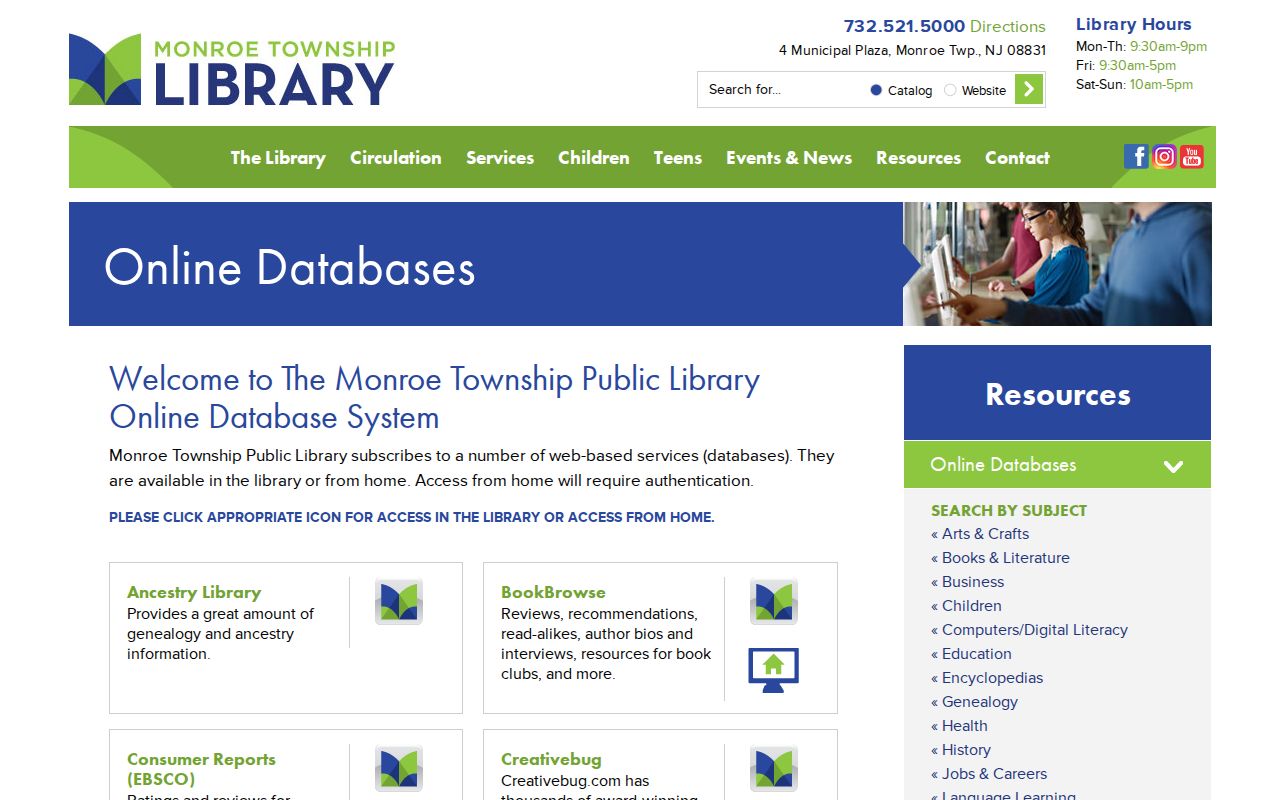
Library access can connect a surname or street clue to census, vital, land, court, and newspaper material, even when a confirmed local city-directory volume is not yet in hand.
Reading a Monroe Township City Directory Entry
A Monroe Township city directory entry has to be read from the volume in front of you because publishers used different symbols and layouts. Typical American entries may give an alphabetic name, street address, occupation or business connection, a spouse in parentheses, widow notation, and sometimes an owner or renter mark. A street section, if present, may turn the search around by listing a street number and occupant. Treat every abbreviation as volume-specific until its printed key confirms the meaning.
| Name | Record the surname, given name, initials, and every spelling exactly as printed. |
|---|---|
| Relationship note | A spouse in parentheses or a widow notation can point to a marriage, death, or earlier surname to verify elsewhere. |
| Address | Keep the house number, street spelling, village or postal label, and any residence marker together. |
| Occupation or business | Use it as a historical clue, then verify an affiliation through a dated source rather than assuming it identifies a current residence. |
| Volume citation | Save publisher, year, page, image or call number, and the abbreviation key used for interpretation. |
- Criss-cross directory
- A directory arranged by street and number rather than only by surname. It may help connect an address to an entry when that section exists.
- Householder index
- An alphabetical listing built around households or named residents. Its scope must be checked in the actual volume.
- Abbreviation key
- The publisher's printed explanation of shortened words and marks. Photograph or cite it before expanding a term by guesswork.
Monroe Township City Directory Gaps in Newspapers
When two directory dates cannot be located, newspapers can supply a dated bridge. The library provides The Star-Ledger through NewsBank, and the searchable Monroe digital community archive offers date-range searching with text-reading controls. Search a surname with initials, a spouse's name, an old village label, and an abbreviated street form. Obituaries, marriage notices, legal notices, property announcements, and civic reports can show where to look next.
A newspaper item is not proof that a person lived at an address on the publication date. It can preserve a name, relationship, event, or locality that should be checked against a directory, census, deed, vital record, or probate file. The archive interface is a newspaper channel, not evidence that it contains digitized city directories or a complete obituary index.
Note: Preserve the newspaper title, issue date, page or image reference, search spelling, and the full text needed to identify the person later.
Monroe Township Directory Names Across Boundaries
Historical Monroe searches need more than a modern place name. Monroe was formed from South Amboy in 1838, and later boundary changes involved Millstone, East Brunswick, Cranbury, and Jamesburg. A family, farm, road, or parcel can appear under one of those jurisdiction names in a date-specific record. The township's rural past also means older material may use farm names, crossroads, mills, or parent tracts instead of a modern house number.
The federal census follows a 72-year release rule, with public releases reaching through 1950. Use a directory date as one snapshot and census as a decennial household snapshot, then allow for normal differences. A different address may reflect a move, an alternate business location, a changed municipal label, or a different member of a household. It does not settle identity by itself.
The Middlesex County Museum & Historical Society is a useful place to ask about Monroe villages, farms, historic maps, schools, cemeteries, community groups, and vertical files. Its public site did not disclose a Monroe surname index or a city-directory inventory.
The Middlesex County Museum & Historical Society provides a visual starting point for county history and map-related questions.
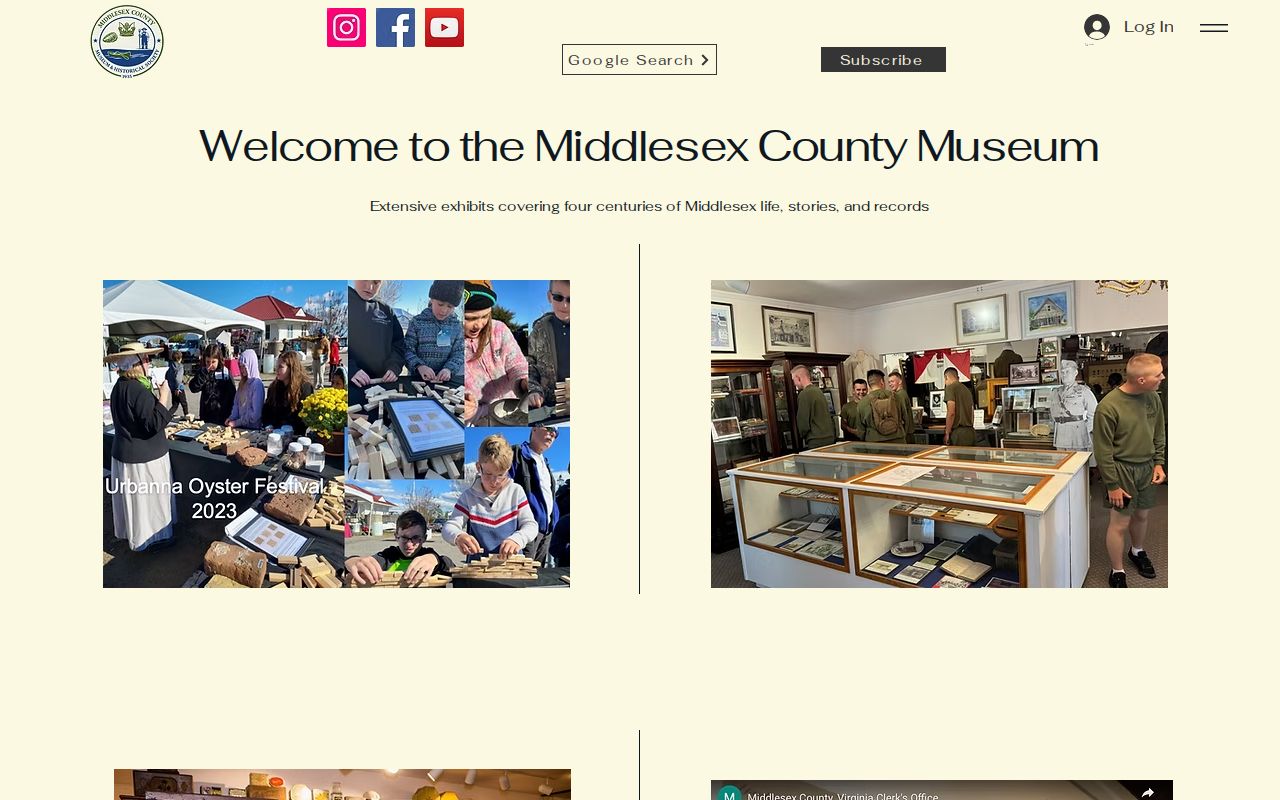
Maps and collection leads can help a researcher retain former place names separately from the modern Monroe Township label.
Earlier Monroe Township Families at State Archives
The New Jersey State Archives genealogy collections provide the documented route before local web portals. Archives holdings include vital indexes, state and federal census material, deeds, surrogate books, court and Chancery files, newspapers, naturalizations, military records, and name-change material. County deeds are described as available on microfilm to 1900, while collection access and date spans still need to be confirmed for the record being sought.
State Archives research also helps distinguish a historical resident from a directory lookalike. Delayed births, older vital indexes, state censuses from 1855 through 1915, and court or surrogate sources can add an age, relationship, event date, or county trail. Church registers can be valuable, but preserve the congregation, volume, page, and date because a church entry is not automatically civil proof.
Tracing Households Through Monroe Township City Directories
Build the household trail one cited record at a time. Start with the exact spelling and municipality on a modern parcel or map result, then keep the block and lot or legal description where it is known. Search the surname in a verified directory volume, any reverse section, the library databases, and the newspaper archive. A city directory can supply a useful address clue, but the county deed chain identifies legal parties rather than every person who stayed in a home.
- Locate the earliest confirmed name or address entry and capture its page, year, publisher, and abbreviation key.
- Search forward through the next available volumes, recording initials, spouses, business addresses, and street changes without silently merging similar names.
- Check the same street in a reverse or criss-cross section only when the volume has one, then compare the alphabetic entry.
- Pair a directory date with the nearest released census and note what each source actually says about the household.
- Use a newspaper notice, eligible vital index, probate file, or recorded deed to test whether a move, widow notation, or inheritance explains the change.
A name that disappears may signal a move, death, a changed listing convention, a skipped publication year, or an unconfirmed gap in the collection. It is not enough to declare a reason. For a backward address trail, use the separate past residents resource to follow recorded conveyances and historical sources by property.
Documenting Monroe Township City Directory Evidence
The strongest result is reproducible. Photograph or transcribe the entry only as far as needed, then retain the directory's title page and abbreviation key with it. A research log should separate what is printed from what is inferred. For example, a spouse notation can suggest a relationship, while a later death index or obituary may be needed to confirm it. A listed address can be historical, a business location, or a mailing point rather than a present household location.
No Monroe-specific first directory year, last year, publisher change, reverse-directory sequence, or local records-loss event was verified in the inspected sources. The responsible next step is to ask the library, county museum, and State Archives about collection histories, not to fill the gap with a plausible-looking date range. That restraint keeps a Monroe Township city directory search useful for family history and estate research.